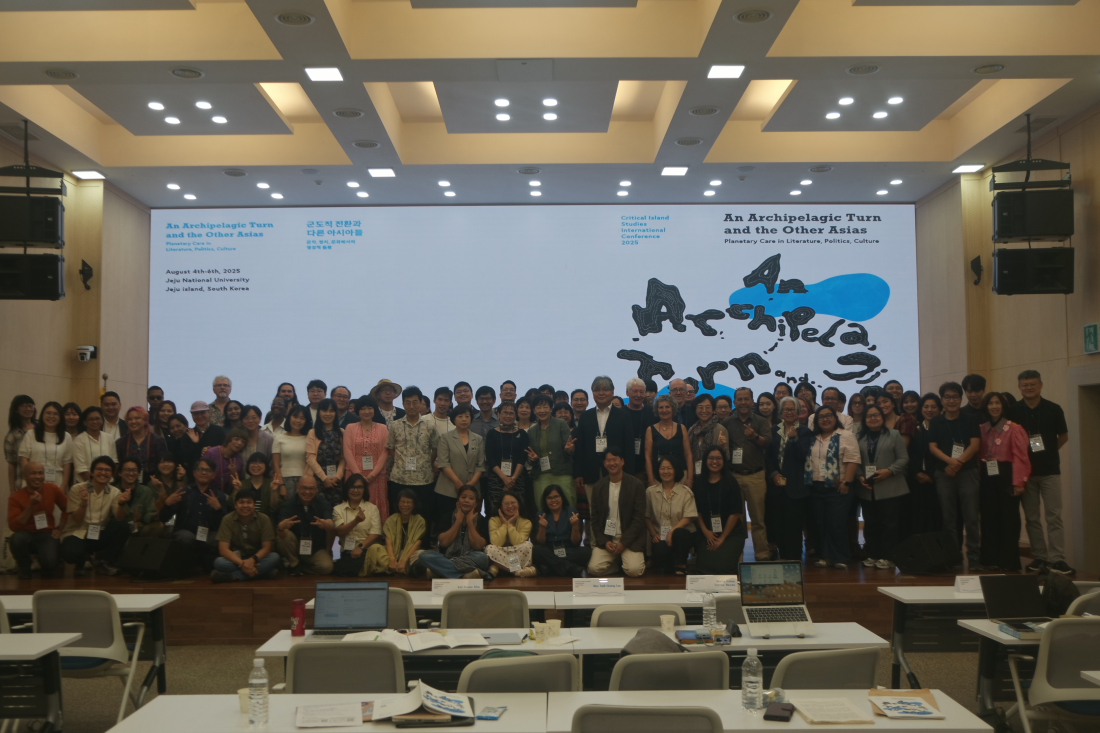
The 2025 Critical Island Studies International Conference was held on Jeju Island, South Korea, from August 4 to 6, 2025. The conference was jointly organized by the Center for Cross-Cultural Studies at Kyung Hee University, the Research Institute for the Tamla Culture at Jeju National University, and the Research Institute of Korean Studies at Korea University, with support from the National Research Foundation of Korea and the Korean Association of Literature and Film. This major international academic event brought together approximately 200 scholars from 22 countries to explore new ways of understanding the world through the study of islands and archipelagic thinking.
The theme of the conference was “An Archipelagic Turn and Other Asias: Planetary Care in Literature, Politics, and Culture.” The conference aimed to move beyond traditional European-centered perspectives that focus mainly on continents. Instead, it explored how islands and oceans can offer new ways of thinking and responding to global challenges. Through discussions of literature, politics, and culture, participants considered new approaches to understanding the world and addressing the challenges facing our planet.
One of the highlights of the conference was the keynote lecture by Gayatri Chakravorty Spivak, a world-renowned scholar and leading figure in postcolonial studies. Spivak is widely known for her influential essay “Can the Subaltern Speak?” Her work has examined important issues such as European imperialism, neocolonialism, racial discrimination, and the global division of labor. In her keynote lecture, titled “Selling Planetarity,” she shared her insights into the limitations of conventional ways of thinking about the world and reflected on the influence of modern capitalism on our understanding of global issues.
Critical Island Studies is a field of research that challenges traditional knowledge systems centered on the Northern Hemisphere. It highlights the importance of islands as places that can offer new perspectives on globalization, environmental issues, and the relationship between people and nature. The conference brought together scholars from various fields, including literature, politics, culture, environmental studies, anthropology, and social sciences, to discuss the future of Critical Island Studies and the possibilities of archipelagic thinking. By exploring island experiences, geographical perspectives, feminist ideas, the relationship between people and marine environments, and ecological approaches that challenge colonial ways of thinking, the conference aimed to open new directions for research and academic discussion.